





Coolant heaters for stationary and marine engines

Jacket Water Heater

Four series from 0,5 to 26 kW

A jacket water heater keeps the coolant of a stationary or marine engine at temperature while the engine stands still, so it starts easily and takes load straight away. Our heaters sit outside the engine, in a bypass on the coolant circuit.

We cover 0,5 to 26 kW in four series: Zerostart, FlowStart, TopStart and our own POWERHEAT line for 150 to 500 litres on 400 to 690 V. Below: how to choose, how we size a unit, thermosiphon or forced flow, and which heater suits a standby generator.

European made, CE marked Datasheets as open PDF 0,5 – 26 kW from one supplier
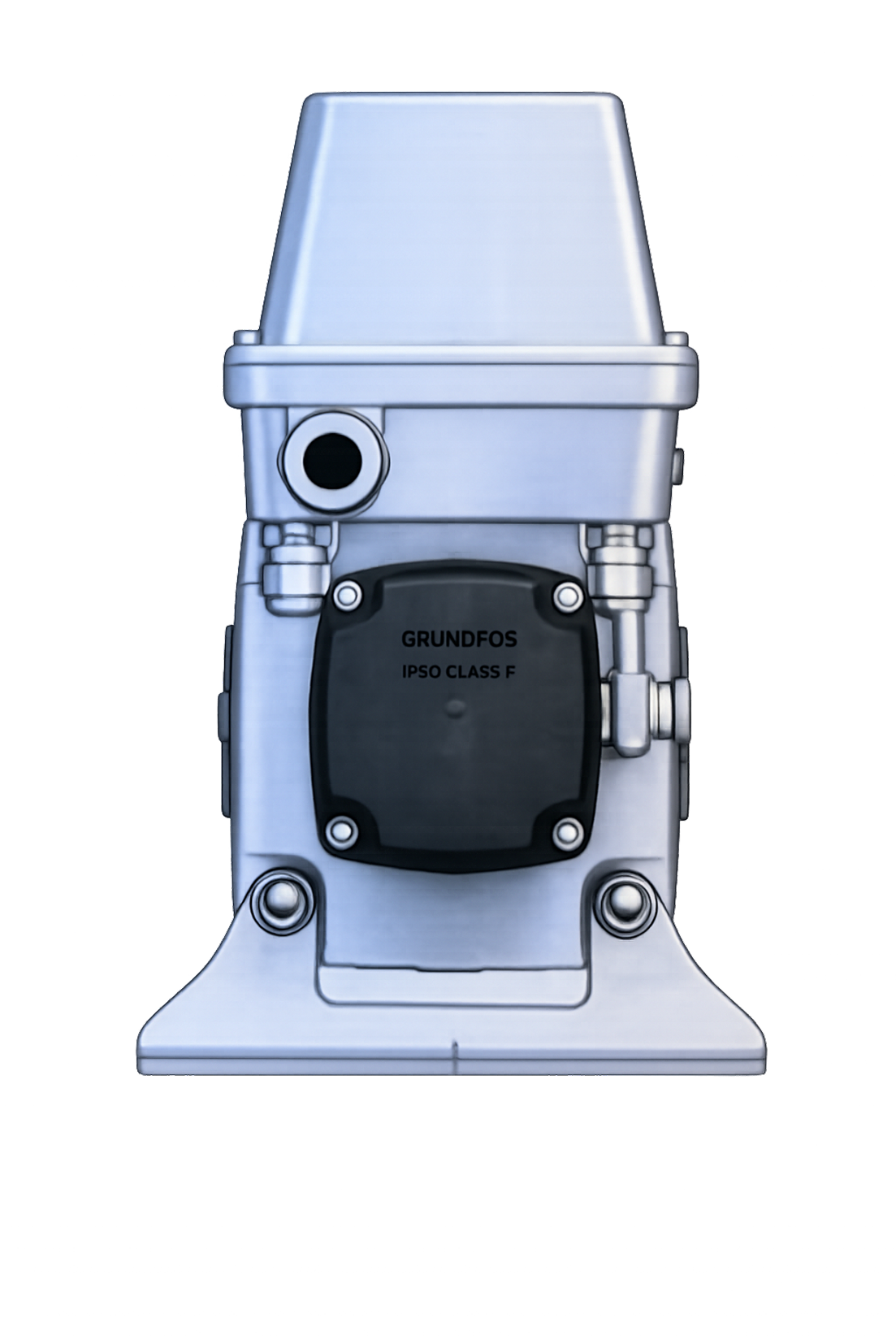
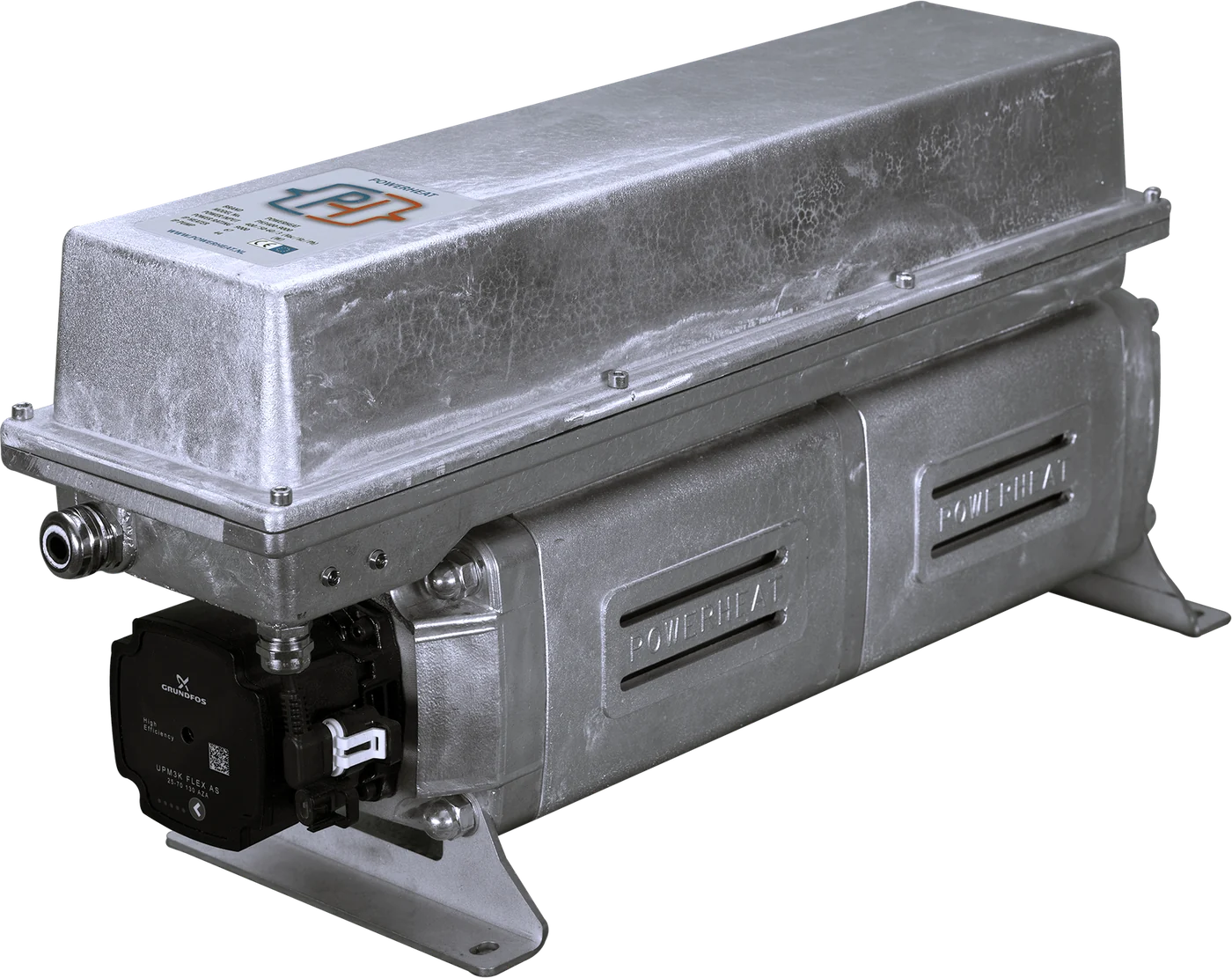
Jacket water heater POWERHEAT 12 to 26 kW with integrated circulation pump
POWERHEAT · 12 – 26 kW
Our own line
0,5 – 26 kW
Four series, one supplier
150 – 500 L
Coolant volume on POWERHEAT
400 – 690 V
Three phase options
CE
European made, CE marked
Power generation engines preheated with a jacket water heater
Power generation
Heavy duty engines preheated with a jacket water heater
Heavy duty
Industrial engines preheated with a jacket water heater
Industrial
Marine engines preheated with a jacket water heater
Marine
Oil & gas engines preheated with a jacket water heater
Oil & gas
Rail engines preheated with a jacket water heater
Rail

The same four series serve every one of these duties, from a 0,75 kW narrowboat engine to a 500 litre standby set.

01 Selection

What decides which unit you need

Four details decide the unit: the coolant volume, the supply voltage, whether the heater needs its own pump, and the coolant temperature the engine builder asks for. With those, the series and the output follow directly.

Coolant volume+

Up to about 30 litres: Zerostart or FlowStart. 30 to 150 litres: TopStart. 150 to 500 litres: POWERHEAT 12 – 26 kW. The volume is in the engine manual; send us the make and model and we check it.

Supply voltage+

Zerostart, FlowStart and TopStart 1 – 3 kW run on 120 or 230 V single phase. Larger TopStart units run on 230 to 690 V, POWERHEAT on 400 to 690 V three phase.

Pump or thermosiphon+

Zerostart has no pump: the heated coolant rises into the block by convection. FlowStart, TopStart and POWERHEAT have an integrated pump, so they heat larger volumes evenly and can be mounted where there is room.

Target temperature+

Engine builders usually specify 40 to 55 °C. Zerostart and FlowStart have fixed thermostats; TopStart is adjustable from 0 to 80 °C and POWERHEAT from 20 to 90 °C.

"WE ONLY NEED A SMALL ONE"

Then you get a small one. We size on coolant volume, so a 10 litre engine gets a 0,75 kW Zerostart, not a 4 kW unit.

"WILL IT FIT OUR ENGINE?"

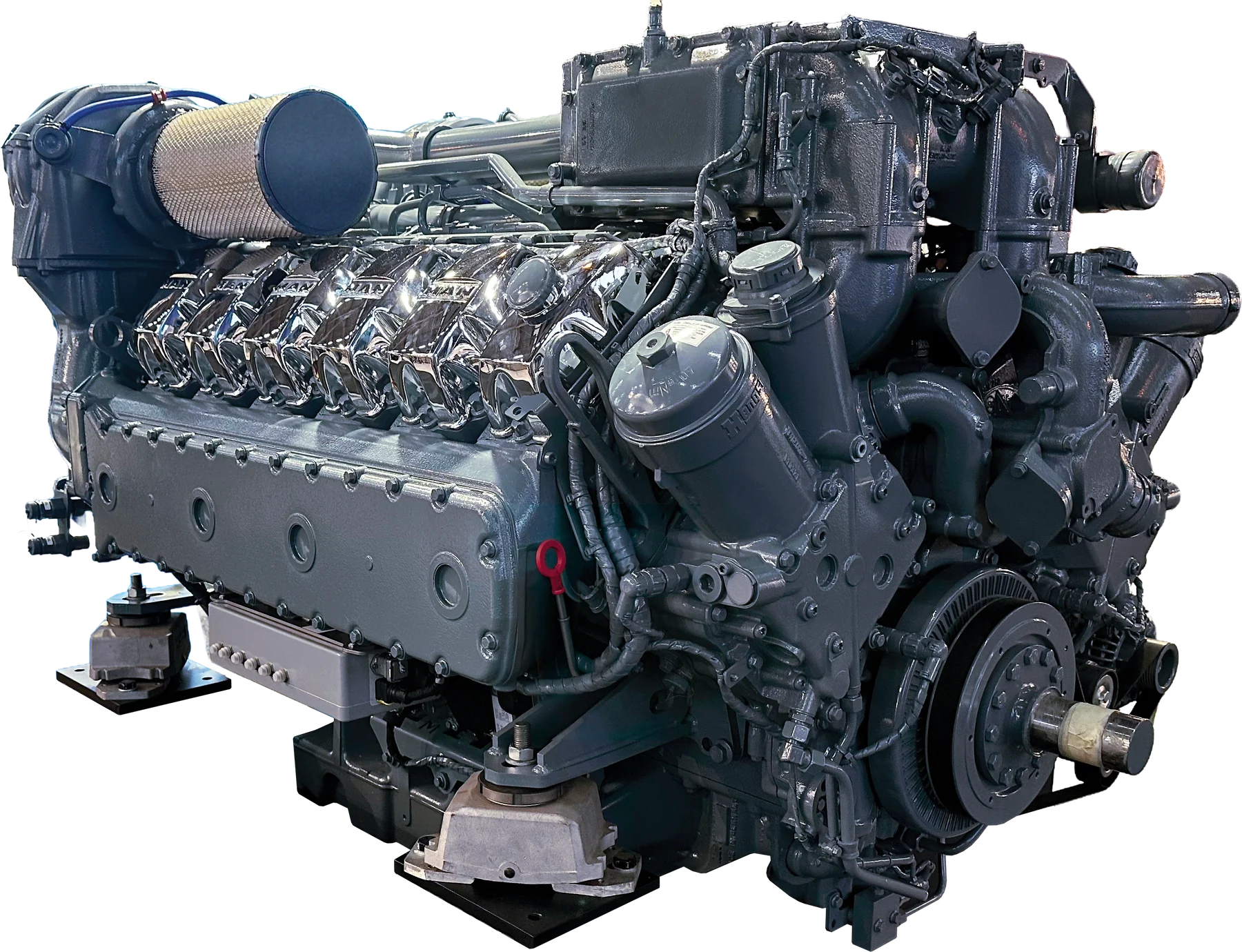
The heater is fitted in bypass with two hoses and a bracket, so the engine is not modified. We fit Caterpillar, Cummins, MTU, Perkins, Volvo Penta, MAN and other makes.

"IT WILL BE A HASSLE"

Datasheets for every series are open PDF downloads, so you can check the fit first. One supplier covers 0,5 to 26 kW, so one enquiry covers the whole fleet.

Send the engine type and coolant volume
Contact Us An engineer replies with the unit that fits and its datasheet.
02 Process

How we size your unit

Sizing takes one exchange. You send the engine make and model, the coolant volume, the available voltage and where the engine stands. Our engineers check the figures against the engine data and reply with the unit and its datasheet.

What we size on+

Coolant volume first, because that is the mass the heater has to warm. Ambient conditions second: an engine in an unheated yard or on an open deck needs more output than one in a heated engine room. Target temperature third, taken from the engine manual.

Thermostat+

Zerostart comes with a fixed thermostat in one of three ranges (16 – 27, 27 – 38 or 38 – 49 °C); FlowStart is fixed at 34 – 40 or 35 – 50 °C. TopStart is adjustable from 0 to 80 °C, POWERHEAT from 20 to 90 °C.

Mechanical fit+

Zerostart connects with 5/8" or 3/4" hose, FlowStart with 5/8", TopStart with 3/4" and POWERHEAT with 1" connections. TopStart is delivered with a connection kit and a fixation kit; the 1 – 3 kW unit weighs 4,6 kg.

Electrical connection+

Units up to 3 kW run on a 230 V supply. Above that the heater is three phase and is connected by an electrician; three phase TopStart units come with a control box.

Questions about your engine? Our engineers size the unit with you.Contact Us →
STEP 01
You send four figures
Engine type, coolant volume, voltage, ambient conditions.
STEP 02
We propose a unit
Series, output and voltage, with the datasheet.
STEP 03
Thermostat range
Matched to the temperature in your engine manual.
STEP 04
Fitted in bypass
No changes to the engine itself.
03 Comparison

Thermosiphon or forced flow jacket water heater

The first choice is how the coolant moves. A thermosiphon heater (Zerostart) relies on convection and suits engines up to about 30 litres. A forced flow heater (FlowStart, TopStart, POWERHEAT) has its own pump and covers everything up to 500 litres.
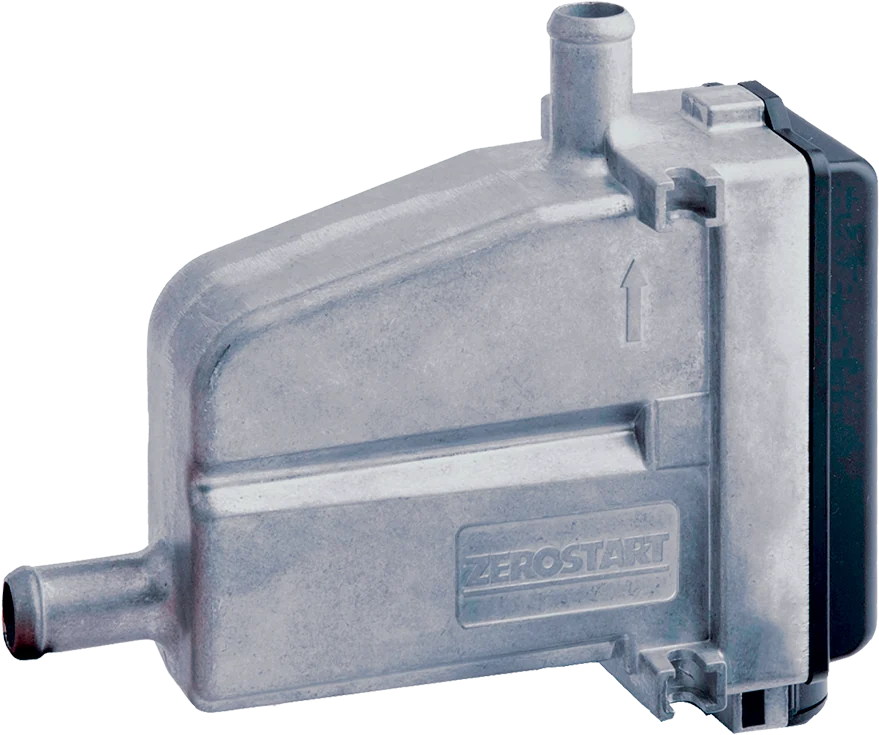
Zerostart thermosiphon coolant heater for engines up to 30 litres
THERMOSIPHON
Zerostart · 0,75 – 2,25 kW
No pump, no motor. Up to about 30 litres of coolant, on 120 to 240 V.
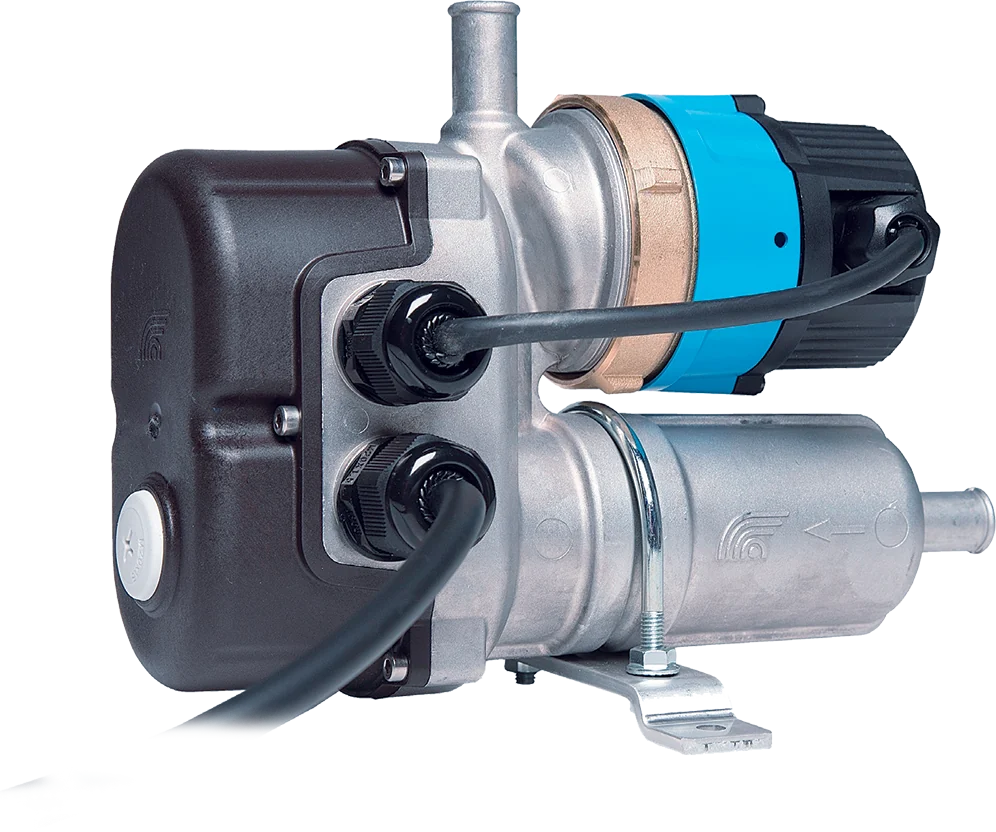
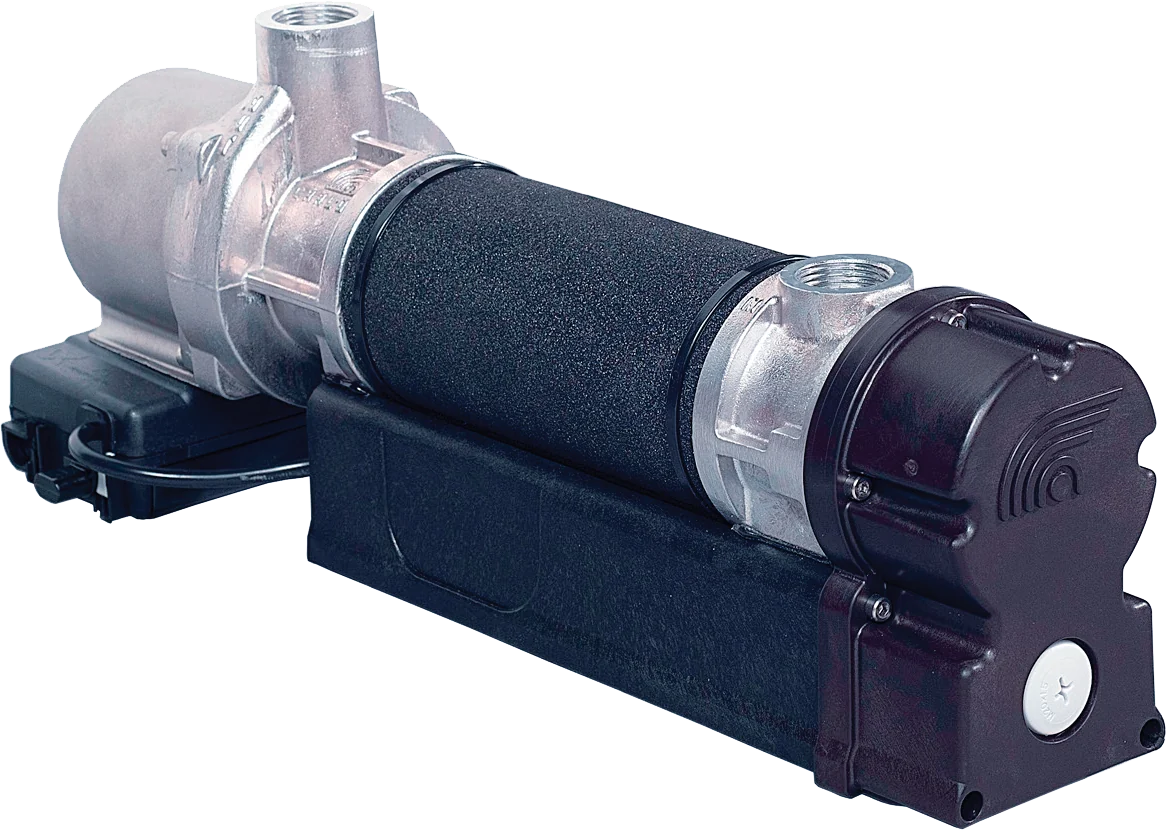
POWERHEAT forced flow coolant heater with integrated circulation pump
FORCED FLOW
FlowStart, TopStart, POWERHEAT · 0,5 – 26 kW
Integrated pump, 30 to 500 litres, up to 690 V three phase.
Thermosiphon · how it works+

Heated coolant rises out of the heater into the block and cooler coolant flows back in at the bottom. There is no motor to wear, but the heater must sit low on the block with rising hoses. Zerostart covers 0,75 to 2,25 kW.

Thermosiphon · supply and fitting+

120, 230 or 240 V single phase. 5/8" hose up to 1500 W and 3/4" hose from 1500 to 2250 W. Fixed thermostat in three ranges between 16 and 49 °C.

Forced flow · how it works+

An integrated pump circulates the coolant, so the heater can be mounted where there is room and still heats the whole engine evenly. Outputs run from 0,5 kW (FlowStart) through 1 – 9 kW (TopStart) to 12 – 26 kW (POWERHEAT).

Forced flow · supply and fitting+

From 120 V single phase up to 690 V three phase. Above 3 kW the unit is three phase and is connected by an electrician.

The rule we apply+

Under 30 litres with single phase available: thermosiphon. Above 30 litres, or when the heater cannot be mounted low on the block: forced flow.
Questions about your engine? Our engineers size the unit with you.Contact Us →
Zerostart thermosiphon coolant heater
ZEROSTART
FlowStart forced flow coolant heater with integrated pump
FLOWSTART
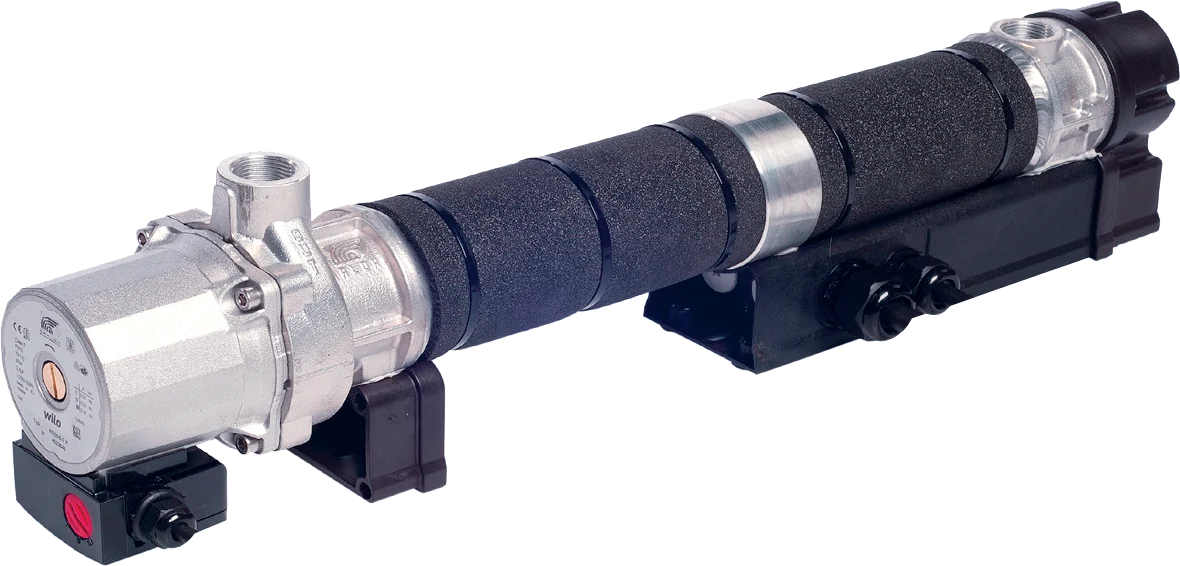
TopStart 1 to 3 kW forced flow coolant heater
TOPSTART 1 – 3 kW
POWERHEAT 12 to 26 kW coolant heater
POWERHEAT
Comparison axis Thermosiphon (Zerostart) Forced flow (FlowStart, TopStart, POWERHEAT)
Circulation Natural convection, no pump Integrated circulation pump
Power band 0,75 – 2,25 kW 0,5 – 26 kW
Coolant volume Up to about 30 L 30 – 500 L
Thermostat Fixed, 16 – 49 °C in three ranges Fixed (FlowStart), adjustable 0 – 80 °C (TopStart) or 20 – 90 °C (POWERHEAT)
Supply voltage 120 / 230 V single phase 120 – 690 V, single or three phase
Installation Two hoses, 5/8 – 3/4 inch, mounted low on the block Pump wired, electrician above 230 V, bracket mounted
04 Application

Which heater fits a standby generator

For a standby generator the coolant volume decides the series, not the kVA rating. Up to 30 litres: Zerostart or FlowStart. 30 to 150 litres: TopStart 1 – 9 kW. 150 to 500 litres: POWERHEAT 12 – 26 kW on 400 to 690 V.

Worked example+

A set with 90 litres of coolant and 400 V available takes a TopStart in the 4 – 9 kW range; the exact output depends on whether the set stands indoors or in an outdoor enclosure.

Where it earns its place+

Standby sets for data centres, hospitals and fire pumps stand still for weeks and must then take load within seconds. Held at 40 – 55 °C they start cleanly and with less wear. More on the standby generator coolant heater page.

When we advise against a heater+

An engine that runs continuously stays warm on its own and gains nothing from a heater. The same goes for an engine in a room kept at its target temperature.

Questions about your engine? Our engineers size the unit with you.Contact Us →
POWERHEAT jacket water heater installed alongside a standby generator engine
SIZING BY COOLANT VOLUME
Up to 30 LZerostart / FlowStart
30 – 150 LTopStart 1 – 9 kW
150 – 500 LPOWERHEAT 12 – 26 kW
Final sizing depends on ambient temperature and target coolant temperature.
The four series

Which unit fits your engine

Zerostart thermosiphon coolant heater
Thermosiphon01
Zerostart
0,75 – 2,25 kW
Up to about 30 litres, 120 to 240 V, fixed thermostat 16 – 49 °C.
FlowStart forced flow coolant heater with integrated pump
Small forced flow02
FlowStart
0,5 – 2 kW
Integrated pump, 120 or 230 V, fixed thermostat 34 – 50 °C.
TopStart forced flow coolant heater
Forced flow03
TopStart
1 – 9 kW
120 to 690 V, integrated pump, thermostat adjustable 0 – 80 °C.
POWERHEAT jacket water heater 12 to 26 kW
High capacity04
POWERHEAT
12 – 26 kW
150 to 500 litres, 400 to 690 V, adjustable 20 – 90 °C, IP67.
Technical documents

Datasheets as open PDF downloads

Zerostart
0,75 – 2,25 kW
FlowStart
0,5 – 2 kW
TopStart 1 – 3 kW
1 – 3 kW
TopStart 4 – 12 kW
4 – 12 kW
POWERHEAT 12 – 18 kW
12 – 18 kW
POWERHEAT 20 – 26 kW
20 – 26 kW
Voltage, output, thermostat range, connections, weight and dimensions per model.Contact Us →

Frequently asked questions about jacket water heaters

Can a jacket water heater be retrofitted to an existing engine?+

Yes. The heater is connected in bypass with two hoses, so the engine itself is not modified; at most a bracket and the hose connections change. On older blocks we ask for a photo of the available tappings before we confirm the connection points.

When is preheating not necessary?+

On an engine that runs continuously, or one standing in a room kept at its target temperature. Preheating pays where an engine stands still and must then start and take load quickly: standby gensets, fire pumps, emergency sets and marine engines.

What temperature should the coolant be held at?+

Most engine builders specify 40 to 55 °C; the exact figure is in the engine manual. Zerostart and FlowStart have fixed thermostats, TopStart is adjustable from 0 to 80 °C and POWERHEAT from 20 to 90 °C.

Does a jacket water heater need a three phase supply?+

Only for the larger units. Zerostart, FlowStart and TopStart 1 – 3 kW run on 120 or 230 V single phase. From about 4 kW the heater runs on three phase: TopStart up to 690 V, POWERHEAT on 400 to 690 V.

What happens if the heater is undersized?+

Nothing harmful. In a bypass system an undersized heater only takes longer to bring the coolant to temperature; an oversized one gets there sooner and then switches off on its thermostat.

What is the difference between Zerostart and TopStart?+

Zerostart is a thermosiphon heater without a pump, 0,75 – 2,25 kW, for small engines. TopStart has an integrated pump and a thermostat adjustable from 0 to 80 °C, from 1 kW up to the 4 – 9 kW range on up to 690 V.

Which heater suits a narrowboat or small marine engine?+

Small marine engines take a Zerostart or FlowStart on 230 V shore power. FlowStart has a pump, which helps when the heater cannot sit below the engine. Larger workboat engines move up to TopStart or POWERHEAT.

Are the heaters made in Europe?+

Yes. About 90 % of what we supply is produced in Europe: POWERHEAT in France, TopStart in Belgium. Every unit is CE marked.

SEND YOUR ENGINE DETAILS

Four details and we name the unit

Engine type, coolant volume, available voltage and ambient conditions. We reply with the unit that fits and its datasheet.

Five fields, one unit proposal
Reply with the matching datasheet European made, CE marked No account, no newsletter
Water-cooled diesel engine
Engine preheating
POWERHEAT 12 to 26 kW coolant heater
POWERHEAT · 12 – 26 kW
TopStart 4 to 9 kW forced flow coolant heater
TopStart · 4 – 9 kW
FlowStart forced flow coolant heater
FlowStart · 0,5 – 2 kW
Zerostart thermosiphon coolant heater
Zerostart · 0,75 – 2,25 kW